
Imagine you want to move $2,000 from a bank account to buy ETH on an exchange, execute a split order across two tokens, and set aside some BTC in cold storage. You sit down, open your browser, and the first friction point is the login and verification flow. This moment — not the market or the chart — determines whether you can act at all. For US-based traders who are weighing OKX as a primary trading venue, that sequence (signup → KYC → account protections → spot trade execution → withdrawal) is the operational reality. The choices made at each step shape fees, safety, and the ability to access Web3 features later.
In this commentary I’ll unpack how OKX’s spot-trading experience works in practice, correct common misconceptions, and give decision-useful heuristics: when to use OKX’s centralized spot book versus its Web3 wallet, how to think about custody trade-offs, and what to watch next in a market where traditional finance and crypto are cross-pollinating fast.
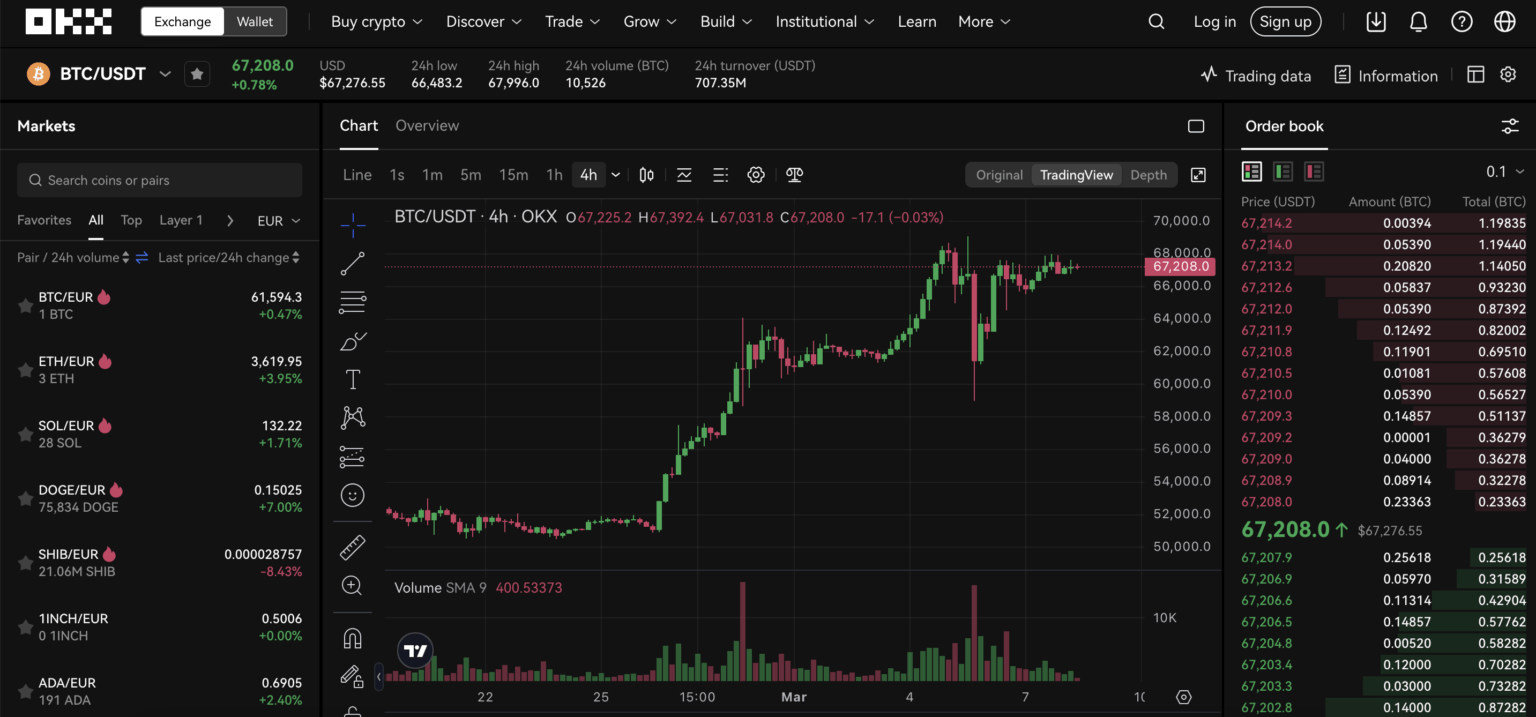
How OKX spot trading works — mechanism, not marketing
At base, spot trading on OKX is a centralized limit-and-market order book: you place an order to buy or sell a listed asset and execution happens against another user’s order or the available liquidity. Mechanically, the platform offers market orders (take liquidity immediately), limit orders (post and wait), and conditional orders (stop-loss/take-profit). For US traders the practical additions are margin modes — isolated and cross-margin — which permit borrowing up to 10x for spot-margin pairs, and the usual caveats about interest and margin calls.
Two things matter more than a prettier chart. First, liquidity: major pairs like BTC/USD or ETH/USDT typically have tight spreads and deep order books; exotic alt pairs do not. Second, routing and slippage: OKX’s DEX aggregator is built to source liquidity across venues, but when you trade on the centralized spot book you are often subject to the visible bid-ask and immediate on-platform liquidity. During fast moves slippage and wide spreads can make market orders costly.
Login, KYC, and account security — the actual barriers to entry
OKX’s account architecture blends centralized exchange controls with Web3 optionality. To create a fully functional account you must complete KYC: government ID plus a liveness check, as the platform needs to comply with AML rules. For US residents this means plan for ID scanning, some waiting, and occasional additional checks. Once KYC is cleared, OKX layers mandatory Two-Factor Authentication (2FA) and offers biometrics on mobile apps.
Security is not purely technological; it’s procedural. OKX stores over 95% of assets in air-gapped, multi-signature cold wallets — a long-standing defense that reduces exchange-level custodial risk. At the same time, account-level defenses include military-grade encryption and AI-driven login detection. These controls materially lower the chance of an exchange-level heist, but they do not prevent phishing, SIM-swaps, or the consequences of reusing weak passwords. For US traders, enable Google Authenticator or hardware keys where possible and treat SMS 2FA as a fallback rather than your main defense.
Myth vs reality: custody, decentralization, and staking
Myth: “If I keep assets on OKX I’ve given up all decentralization and control.” Reality: There are trade-offs. Holding assets in OKX’s custodial accounts is convenient for fast spot trading, immediate liquidity, and access to staking and derivatives. The exchange’s Proof of Reserves provides on-chain transparency that helps verify backing, which is a stronger assurance than many older platforms offered. But custody by a centralized exchange inherently means counterparty risk: you rely on the exchange’s operational security, internal controls, and compliance — not on having your own private keys.
For traders who want Web3 control, OKX also offers a non-custodial Web3 wallet (seed-phrase based) with hardware-wallet compatibility. That wallet lets you use DeFi, the OKX DEX aggregator, and the NFT marketplace across many chains. The trade-off is clear: self-custody reduces counterparty risk but increases personal responsibility. If you lose your seed phrase, there’s no recovery. If you interact with DeFi protocols, you accept smart-contract risk.
Spot vs margin vs DeFi: a decision framework
Here is a simple heuristic for US traders deciding where to place assets in the OKX ecosystem: 1) Active spot trading capital: keep on the CEX for instant execution and access to margin (if you use it). 2) Medium-term holdings and staking: consider a hybrid approach — keep a portion custodial for liquidity and stake via OKX for yield, and move the rest to your non-custodial wallet if you value absolute control. 3) Long-term cold storage: use hardware wallets or withdraw to your own multisig vault. This framework balances execution speed, yield opportunities, and security.
Remember fees and settlement: withdrawing between chains can incur bridge fees and network congestion delays. US-regulated funding rails add another layer — fiat deposits and withdrawals may have limits or delays depending on banking partners and AML checks.
Where OKX’s integration matters and where it breaks
Integrated features give practical benefits: TradingView charting on the web platform improves technical execution; the mobile app with biometric logins speeds re-entry during volatile markets; the DEX aggregator can reduce slippage when swapping tokens across chains. On the other hand, combined systems create systemic attack surfaces: a vulnerability in a browser extension or a third-party bridge can affect on-chain assets even if an exchange’s custodial ledger is secure. This is why separating custodial spot capital from active Web3 experimentation is not just a psychological preference — it reduces correlated operational risk.
Another boundary condition: leverage. OKX offers high leverage on derivatives (up to 125x for some futures) and up to 10x for margin spot. That capability is tempting, but it also compresses error tolerance. For most US retail traders, smaller leverage or none at all is a pragmatic choice; the speed of liquidation and regulatory clarity about leverage products make high leverage a professional tool, not a beginner aid.
Near-term signals to watch (conditional scenarios)
One relevant signal is institutional capital flows and regulatory posture. Recent reports indicate deepening ties between legacy finance and crypto, which could increase liquidity and product availability on regulated pathways. If traditional exchanges or major institutions expand partnerships with crypto venues, expect tighter spreads on major pairs and more fiat on-ramps — but also stricter compliance. Another trigger to watch: major smart-contract exploits or bridge failures could push more traders toward custodial liquidity; conversely, widely adopted secure custody solutions could accelerate self-custody migration.
These are conditional scenarios: none are certain, but each would change the trade-offs around speed, custody, and where you place capital.
Practical login and first-trade checklist
Before you click “Buy” on the spot screen, check these items: 1) Complete KYC and confirm email/phone; 2) Enable 2FA (prefer an authenticator app or hardware key); 3) Fund the account using a supported fiat route or crypto transfer; 4) Understand the pair’s liquidity and expected spread; 5) Use limit orders if you care about execution price; 6) Consider withdrawing to a hardware wallet if you won’t trade the asset soon. If you need a direct path to sign up or log in, the exchange provides a dedicated login page accessible via this link: okx.
FAQ
Can I trade spot immediately after creating an OKX account in the US?
Not always. You must complete KYC verification before full functionality is unlocked. KYC typically requires a government-issued ID and a facial liveness check; processing time varies. Planning for a short verification delay is prudent if you expect to act on near-term price moves.
Is it safer to keep crypto on OKX or in a hardware wallet?
It depends on your priorities. Keeping assets on OKX offers convenience, immediate liquidity for trading, and staking options; the exchange’s cold-storage practices and Proof of Reserves reduce counterparty risk compared with less transparent platforms. A hardware wallet gives you sole custody and eliminates counterparty risk but introduces personal responsibility (seed phrase security). For most traders the combination of a custodial trading account for active capital and hardware wallets for long-term holdings balances the trade-offs.
What are the real risks when trading spot on OKX?
Primary risks are market volatility, slippage on market orders during fast moves, low liquidity on small-cap tokens, phishing attacks that target login credentials, and smart-contract vulnerabilities when interacting with DeFi features. Exchange-level security reduces the risk of a platform-wide theft but does not eliminate personal operational risks.
Does OKX support staking and yield on spot holdings?
Yes. OKX offers flexible and fixed-term staking, as well as DeFi yield options, sometimes with auto-compounding. These products vary in lock-up and risk, so read terms carefully before committing funds that you might need for trading.
Bottom line: OKX combines a competitive centralized spot book with Web3 pathways and strong custody practices, but nothing removes the need for active security hygiene or a clear custody plan. Understand what you need the asset for — immediate trading, staking yield, or long-term holding — then choose custodial or non-custodial storage accordingly. That discipline, more than any single feature, separates a recurring profitable workflow from a costly mistake.